Saturday, June 24, 2006

Timorese Socialists and Neo Colonialism


August 2005-
Joe Carolan from Socialist Worker interviewed Avelino Coelho, General Secretary of the Socialist Party of Timor (PST).


How did you first get active in the resistance in Timor Leste?
When I was a student I was deeply influenced by socialist views. I was attracted by the idea of building a new society, a new human relationship, without discrimination, based on equality.

How did the events of the Indonesian revolution help the struggle in Timor?
There was in East Timor within Fretilin’s leadership two main paths for achieving independence. One was that with western support and national unity we could win- the view of the moderate “Social Democrats”. The second path is that our revolution lay down the path of Indonesian revolution, struggling for democracy. These two views have determined the internal conflict within the struggle for a very long time.

I continue to believe that Indonesian social transformation will determine East Timor's political path. We were in the right train, because after Suharto fell we won liberation. Fretilin won the election in 2001, and the local elections recently. But its ideology does not represent social transformation on behalf of the poor. . Today there is discrimination- huge differences between rich and poor.


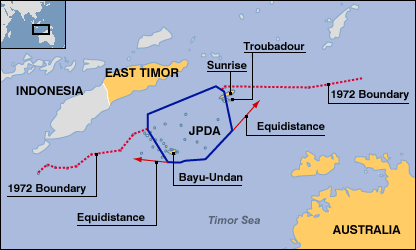
Is Australia now trying to make East Timor a neo-colony because of the oil and gas in the Timor Sea?
Exactly. East Timor is a new colony of Australia economically, and of Portugal linguistically. The elite that runs this country depends on western power. We are free and independent with flags, and a constitution, but economically we are very deeply dependent on big powers that before independence played a strong role in supporting the annexation of East Timor by the Indonesian army


In Ireland, socialists participated in our national revolution in the War of Independence. James Connolly, the Irish Marxist, warned workers to "hold onto your guns". In your view is there a Timorese comprador class emerging?
In East Timor during the struggle the workers, the poorest farmers and youths did the struggling, while the well-established people supported the occupation, preparing themselves for power. Now after independence, the poor are marginalized, while the comprador class takes advantage. The people vote for flags and symbols, but not for a political platform. The elite try to manipulate and exploit the ignorance of the people for their own purpose.


The PST is making gains, increasing its membership and influence at the grassroots. Why does the PST now find it necessary to stand against its old comrades in Fretilin?
Fretilin is not the Fretilin of 1975! It is now the representative of capitalist interests in East Timor. Any policy that's been made is not in the interest of our people. Our agriculture is paralyzed. The workers and farmers are oppressed! This is providing space for PST to increase its support in the struggle for socialism. In the recent local elections, we got significant support. From 450,000 voters PST won 28,000 votes. This figure represents a significant increase, and a possibility for social transformation in the national elections in 2007. We have in front of us two years of hard work! We appeal to whoever that believes in the honourable principles of socialism, justice and equality, to support us!

Monday, June 12, 2006

What does Class mean in the 21st Century?


There is a popular view that class has something to do with lifestyles, income or status. Working class, ‘middle class’ and ruling class people are supposed to have certain accents, different kinds of jobs and housing in separate geographical areas that define their class. However, subjective approaches that attempt to define class by what people consume, where they live or how they speak focus on how people behave, but not on what created class society in the first place. Judging people by these behavior patterns only focuses on surface appearances and does not explain the underlying social relationships which exist within capitalist society. Many theorists have attempted to explain the phenomena of class, but Marx’s contribution was an examination of how modern class society was created, based on the economic processes of exploitation. It is this that separates his concept of class from other philosophers such as Max Weber. Erik Olin Wright addresses this in his paper The Shadow of Exploitation in Weber’s Class Analysis (2002) –
“Nothing better captures the central contrast between the Marxist and Weberian traditions of class analysis than the concept centred on the problems of life chances in Weber and a concept rooted in exploitation in Marx… (Weber) does not see the problem of extracting labour effort as a pivotal feature of class relations and a central determinant of class conflict” (p832).


The origins of modern class society

Marx wrote in 1852-
“I do not claim to have discovered either the existence of classes in modern society or the struggle between them. Long before me, bourgeois historians had described the historical development of this struggle between the classes, as had bourgeois economists their economic anatomy. My own contribution was… to show that the existence of classes is merely bound up with certain historical phases in the development of production…”- Letter to Weydemeyer, 5 March 1852- Quoted in Social Theory- A Historical Introduction, by A. Callinicos (Polity Press, 1999) p84.

Events like the English, American and French Revolutions overthrew the age old rule of kings, and began freeing the productive forces of the urban bourgeoisie to develop both industries and colonial empires, thus creating a new imperialist global economy. In the Communist Manifesto, Marx and Engels see the development of capitalism as a progressive step in history, overthrowing the superstitions of the old feudal class order with the white heat of science and industry. Capitalism represented a higher mode of production from the previous modes of slavery, feudalism and primitive communism (hunter gatherer classless societies).

The bourgeoisie cannot exist without constantly revolutionising the instruments of production…All fixed, fast frozen relations, with their train of ancient and venerable prejudices and opinions are swept away… ( K. Marx, Communist Manifesto, p12).
However, this new industrialised society created its own oppressed class, the proletariat or urban working class. The proletariat is exploited by being forced to sell its labour at a price lower than its true value- the surplus is taken by the capitalist and becomes the chief source of the new system’s ultimate goal- profits. This was accepted by early capitalist thinkers- the classical economists John Locke, David Ricardo and Adam Smith, upon whose theories Marx built his work. Smith argued that
“the real price of everything, what it really costs the men who want to acquire it, is the toil and trouble of acquiring it…It is not by gold and silver, but by labour, that all the wealth of the world was originally purchased, and its value to those who possess it and who want to exchange it for some other object, is precisely equal to the quantity of labour which it enables them to purchase or command”- From the Wealth of Nations, quoted in C. Harman, Economics of the Madhouse, Bookmarks, 1995, p20.

Against this, many bourgeois economists have argued that labour is free to sell itself in a contract with its employer. Although this is true, it negates the fact that without wages the worker will not have money for life’s necessities, and as such, most people are compelled to work. In the age of modern welfare states, few people choose to live a life of poverty on unemployment benefits.

Exploitation and Surplus Value
Decades before Marx developed the labour theory of value in Das Kapital, Adam Smith conceded the fact that capitalists, rather than creating wealth, actually took their profits from wealth created by labour. Profits were derived from what Marx would later call the unpaid surplus value that the working class created.
“In the original state of things, which precedes both the appropriation of land and the accumulation of stock, the whole product of labour belonged to the labourer. But as soon as the land becomes private property, the landowner demands a share of the produce…The produce of all labour is liable to a like deduction of profit… In all manufactures, the greater parts of the workmen stand in need of a master to advance them the materials of their work… He shares in the product of their labour”. Quoted by Chris Harman, Economics of the Madhouse, p23.

Thus, it is argued by Marxists that capitalism is based around exploitation of the majority of people in society, who are compelled by economic necessity to work, by a small minority of landlords, corporations, speculators and capitalists. Those who work to earn a wage from this exploitative minority form the working class- this pattern of class domination and exploitation is repeated intergenerationally. Marx argues in his masterwork, Das Kapital-
“This specific form in which unpaid surplus-labour is pumped out of the direct producers determines the relationship of domination and servitude, as this grows directly out of production itself… On this is based the entire configuration of the economic community arising from the actual relations of production and hence also its specific political form. …in which we find the innermost secret, the hidden basis of the entire social structure and hence also the political form of the relationship of sovereignty and independence….” Marx, Capital. III, p927 (quoted in Callinicos)


Class struggle- the fundamental opposition of class interests
For Marx, the exploitation of the working class differs from previous subordinate classes such as serfs or slaves, in that they are exploited collectively, in massive factories, industries and workplaces. This creates the possibilities for workers to begin organising collectively in combinations or unions, pointing the way to a future collective, egalitarian society where wealth can be democratically owned and shared for the common good. In the Communist Manifesto, Marx notes that-

The proletariat goes through various stages of development. With its birth begins its struggle with the bourgeoisie. At first the contest is carried on by individual labourers, then by the working people of a factory, then by the operatives of one trade, in one locality, against the individual bourgeois who directly employs them…
But with the development of industry, the proletariat increase not only in number, it becomes concentrated in greater masses, its strength grows and it feels it more. (p15)
When Marx was writing, the global working class was equivalent to that of the workers in modern South Korea. Today, the vast majority of the world’s population (and poor) are urban workers, be they in London or Berlin, or in the sprawling conurbations of Sao Paola, Jakarta or Lagos. For Marxists, the principle of democratic control of the economy and the resources produced by collective labour is irreconcilable with private ownership of the means of production.
…At a certain stage of development, the material productive forces of society come into conflict with the existing relations of production, or- this merely expresses the same thing in legal terms- with the property relations within the framework of which they have operated hitherto. From forms of development these relations turn into their fetters. Then begins an epoch of social revolution.
K. Marx, a Contribution to the Critique of Political Economy (London, 1971) p21.


The new middle class?
In modern times, there has been a debate around who constitutes the working class- traditionally; they have been thought to consist of workers in highly unionized manual industries such as mining, shipbuilding, construction etc. However, the proleterianisation of the service industries in recent years has seen nurses, bank officials and teachers not only unionise but take strike action to defend conditions in modern Ireland and New Zealand. These workers although “white collar”, still sell their labour for a wage and are considered by modern Marxists to be members of the working class.

However, modern Marxists do acknowledge the existence of a thin layer of professionals who occupy Contradictory Class positions, such as lawyers, senior managers, university professors etc. These people, whilst paid for their labour by a generous salary, occupy positions of power and status in modern class society, and thus resemble the classical petit-bourgeoisie defined by Marx in the Manifesto. This group can be won to one side or the other of the class struggle by ideological argument, but can be said to benefit from the unequal nature of late capitalist social organisation. (this Marxist analysis of a ‘middle class’ is discussed in greater depth by Lindsey German in ‘ Caught in the Middle?’, A Question of Class, 1996 p66-76)


Implications for social inequality- the Abolition of Private Property

The French Utopian Socialist, Proudhon, before Marx, had declared that “Private property is theft”. In a Marxist class analysis, private property is the ownership of the means of production by a small minority, and it is at the root of social inequality. In the second Part of the Communist Manifesto, Marx distinguishes the difference between the personal objects most working people buy throughout their life with their wages, to which they are entitled, and the ownership of huge industries, corporations and economic sectors by individuals or private cabals.
Communism deprives no one of the power to appropriate the products of society: all that it does is deprive one of the power to subjugate the labours of others by means of such appropriation (p28)

Marx argued throughout his life that the working class, through revolution, will put property and wealth under democratic control, for the use and service of all. Here, Marx addresses those critics who attack the socialists-
You are horrified at our intending to do away with private property. But in your existing society, private property is already done away with for nine-tenths of the population; its existence for the few is solely due to its non-existence in the hands of those nine-tenths (p27).

Marx was not the crude determinist that he is often portrayed as- there will be no natural evolution from the barbaric system of capitalist exploitation based on war, imperialism, racism and sexism to a new collective world unless people consciously organise to bring it about. That is why he placed such emphasis on worker’s self emancipation, helping to organise the First International and many political parties and trade unions. He argued for socialism from below- and that the liberation of the workers was not to be done by anyone but themselves- “Philosophers have only interpreted the world” he once said, “The point is to change it.”

How this democratic control of economics is to be achieved today is still widely debated- some reformist socialists argue for gradual legal change, Partnership, a Third Way or market socialism, whereas radical socialists argue for worker’s councils, a fighting trade union movement and in the wider anti capitalist movement, revolution.

For radical egalitarians, the need to democratise the very economy itself becomes a prerequisite, a fundamental principle of how to organise society and redistribute the resources created collectively. The redistributive principle of the socialist movement can be summed up in Marx’s maxim “From each according to their ability, to each according to their need”. In the 21st century, where 19,000 children starve daily amidst a world of plenty, the urgency of this credo is still with us.


Bibliography

Alex Callinicos, Social Theory- A Historical Introduction, Polity, 1999.

Erik Olin Wright, The Shadow of Exploitation in Weber’s Class Analysis
American Sociological Review, Vol. 67 December 2002.

Chris Harman, Economics of the Madhouse, Bookmarks, 1995

K. Marx, a Contribution to the Critique of Political Economy (London, 1971) p21.

K. Marx, the Communist Manifesto, Phoenix, 1996.

K. Marx, Theories of Surplus Value- (Volume IV of Capital)
Parts 1 and 2- Progress Publishers, Moscow, 1978

Rosemary Crompton, Class and Stratification, Polity, 1998.

Lindsey German, A Question of Class, Bookmarks, 1996

Tuesday, May 30, 2006

Beat the Brands!


After months of recruitment and planning, Unite
union’s drive to organise low paid workers in the
fastfood industry announced itself with the World’s
first Starbucks strike on the 23rd of November 2005.
Less than four months later, the union succeeded in
signing a historic deal with Restaurant Brands,
winning more pay and better conditions for workers in
Starbucks, Pizza Hut and KFC. During these months of
struggle, a new approach to trade union organising was
tried and tested, one that may prove useful to union
activists in other industries and nations. As Unite
gears up for a massive fight with McDonalds
management, Joe looks over the first six
months of SupersizeMyPay.Com, and how a tiny New
Zealand union beat the brands.


I first heard about the Unite fast food recruitment
drive reading Indymedia NZ on the web one evening down
in Hamilton. I had been a trade unionist and a
socialist for over a decade, but in recent years had
been more active outside the worksite in the anti war
and Global Justice movements. These massive
movements often followed major international events,
ebbing and flowing like the tide coming in and out,
but had given a lot of confidence to a new left.
However, the real difficulty of turning this new found
energy, this “Spirit of Seattle”, to build something
solid in the community or the trade union movement had
long eluded activists, leading many to become
disillusioned or cynical again. Here, on the other
side of the world, Unite’s bolshie recruitment looked
to me like the answer.

The article on Indymedia told how the young Unite
organisers had signed up over three thousand fast food
workers to their union, and how they were going to
launch a campaign for better pay and workplace rights.
I congratulated the author, telling them how they
were doing the work of James Connolly and Jim Larkin,
organising the “unorganised”. Within a month, they
had convinced me to stay in New Zealand and help as an
organiser with the SupersizeMyPay.Com campaign.

I had always been a member of a union all my working
life, and as a rank and file delegate had organised
community workers and language teachers in Ireland.
Back home, most socialists had until recently refused
to take up full time positions with unions, as many
were either controlled by right wing bureaucrats who
wedded workers to partnership programmes with bosses
and the government, or were adjuncts of the “afraid to
be a pale shade of pink” neoliberal Labour Party. A
socialist would probably never be offered an
organising position by these kinds of leaderships in
the first place.

But there was another tradition of organising unions-
the tradition of New Zealand's own Red Feds, the American
Wobblies, the Irish TGWU of Larkin and Connolly that
all reminded me of Unite. Unions whose organisers had
no privileges, who were on the average industrial wage
(or less) and who stood for a fight and for change led
from below, by workers themselves. The first few
months was all about learning how to organise and help
workers, and as I found myself around a new city, I
learned how to organise from comrades such as Mike
Treen, Matt McCarten, Piripi Thomson and Simon
Oostermann.

Most rank and file workers know our own workplace and
union branch, but moving beyond this to organise a
whole city sector was a new experience for me. Simon
took me round visiting the Starbucks stores- I had
never been inside one in my life. In a zone that anti
capitalists and socialists had encouraged people to
boycott, he showed me how we could bring the spirit of
the Global Justice fight inside to workers in the
stores. Expecting hostility, I was impressed with the
spirit of solidarity and camaraderie he struck up with
Starbucks workers- it was a revelation to me.

I went out on the bike with Piripi to the KFCs and
McDonalds. Piripi was a great organiser, a young
Maori working class fighter who had had his share of
injustice and hard knocks, but channelled his anger at
the state of the world into building up an
organisation for the working poor. Piripi was
dedicated, devoted and non stop, out on the road
recruiting from six in the morning till 3.30 am.
Workers all over Auckland still remember his passion
as a champion for their rights- he was always standing
up to unjust managers and bosses, fighting for union
members. He helped build up the workplace army that
he unfortunately never would see in battle. He died
only two weeks before the first strikes in Auckland,
out on the road, about to take his first break in
months. The workers movement was robbed of a great
natural leader, and his Tangi at Unite was massive.

Looking back, Piripi’s death was kind of a moment of
truth for Unite. It brought people in the union
together very strongly, and strengthened our resolve
that the work he had begun would be finished as
honourably as we could. Delegates from all the
stronger stores prepared to take action- we would
start with Starbucks, and then move onto KFC and Pizza
Hut.

The first wave
The K Road Starbucks strike was brilliant, especially
when started by the wildcats in St Lukes, Newmarket
and the City Centre. Picking them up on the Workers
Charter Freedom Bus was exhilarating. The media work
done by Matt, Kirsty and Simon was superb, and we won
the initial shots of the propaganda war. But the feel
on the picket line was something else- colourful
placards, loud music, free fair trade coffee,
solidarity spread through a sexy website, flashmob
texts and emails- the techniques of the Global Justice
movement at last harnessed by its trade union cousin.
We knew after that first picket that
SupersizeMyPay.Com was onto a winner.

Every strike after that had its own character and
lesson. The first KFC strike at the flagship Balmoral
store was electric, with even more workers and
supporters turning up in solidarity with a strike led
by possibly the world’s youngest strike committee.
Balmoral provided a model and a process for how a
staunch store goes from high membership to action.
The strike vote meeting and the strike committee were
huge confident boosters for those preparing to strike,
and the solidarity on the day from other union members
and our allies made workers feel the community was
behind them. Strike leader Laurent recounts the
experience-

"When Unite came to KFC Balmoral we were itching for
action. Instantly most of the store was signed up. We
now just had to wait six months until negotiations had
finished.

The whole store was really in to the union with talk
about it constantly happening on shifts. This
familiarised new staff with the union and gave them
the ability to make a decision about it before we
asked them to join. Most did join. The two delegates
Briar and I attended the world’s first Starbucks
strike. It was fricken choice! We talked with the
union, had a stop-work strike committee meeting and on
December 2nd KFC Balmoral led the KFC's in to strike mode.

The KFC Balmoral strike lasted two hours and we were
joined by heaps of brilliant supporters and some staff
from the Die Hard Lincoln Rd store. During the strike
we all had great fun. The initial guts in your mouth
passed really quickly once we got in to it. After the
strike a number of staff made comments that they now
felt empowered or had a voice."

In many stores there was a subtle (and not so subtle)
division used by management between different ethnic
groups that our union needed to take head on. A lot
of stores have problems with the multicultural divide
and rule games that bosses and managers play- e.g.
most brown workers in the union, most Chinese workers
loyal to the Chinese shift managers. Oftentimes we
needed to win unity between workers of different
backgrounds on the store floor first before moving on
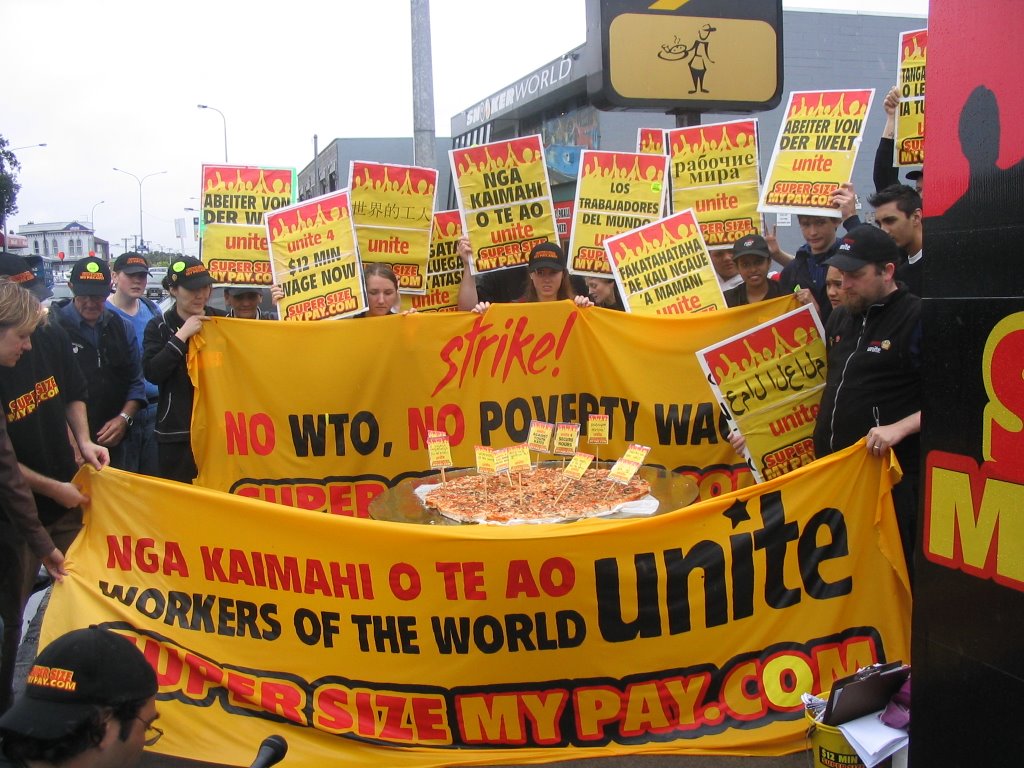
to fight the boss. So on December 17th, placards in
German, French, Spanish, Chinese, Arabic, Maori,
Samoan and Tongan were held up by workers from Asian,
Indian, Pasifika and European backgrounds, graphically
demonstrating the wide range of nationalities and
races that the campaign united. Eight days before
Christmas in the pouring rain, the workers of the
world united on strike outside Pizza Hut in Royal Oak.

"You'd better be clever..."
As Christmas approached and the economic pressures of
the period piled on, there was increasing pressure
coming on us to hit the companies with a spectacular.
Many stores were up for action and strikes on
Christmas Day, New Years Eve and New Years Day that
would have hit the company really hard, both
financially and brand wise. The Irish resistance to
the British Empire had a saying- “If you’re not
strong, you had better be clever”. As a union
representing low paid workers, we knew that many could
not afford to be on strike for days or even weeks at a
time. But when a company pays a worker minimum wage,
it actually supplies her with a weapon. A strike for
a few hours on one of those days might only lose the
worker ten or twenty dollars, but cost the company
thousands. Our weapon was unpredictability, a form of
industrial guerrilla warfare- the no warning,
Lightning Strike.

“If multinationals won’t give us secure hours, then
they shouldn’t get them, either!”
The first Lightning Strike hit the Lincoln Road KFC
branch on the 21st of December. The Lincoln Road
Unite crew were hardcore- they struck in solidarity
with every single strike throughout the Supersize
campaign with Restaurant Brands. A staunch Maori
leadership headed up by the courageous Susan Tainui,
Lincoln Road had a multicultural membership that was
standing up to intimidation and bullying all the time.
A certain ham fisted and clumsily provocative manager
was to act as the villain of the piece- a fast food
version of the Pinkerton Union Busters of old, but a
bully whose own petty mindedness and vindictive
cruelty made him our greatest recruitment officer.

"Our store becoming a strong store led some in
Restaurant Brands to try to stamp out the union. A new
area manager and store manager were brought in and
both tried their hardest to obstruct the union
movement. This made it really hard to recruit new
staff but also made the core of our stores union far
more united." (Laurent, KFC)

Excellent media work from Kirsty and Simon got the
story over on all major TV Channels and print media,
arguing that 2008 was “Far too late!” for a $12 an
hour minimum wage. KFC had been trying to brand
themselves “Kiwi For Chicken” up until then, but after
that day they were forcefully rebranded as hiring
“Kiwis For Cheap”. By this stage, the company was
beginning to cotton on to the fact that we were aiming
for their Brand identity by high profile, media savvy
actions, and to their credit, began to realise that it
would be in their long term interest to minimise the
damage. If anyone with any intelligence in McDonalds
management reads this piece, they should realise that,
from an early stage, the Restaurant Brands management
realised full well why we had named the campaign
SupersizeMyPay.Com. Morgan Spurlock’s documentary
“Supersize Me” had cost the fast food company millions
by rebranding the food on offer as unhealthy and
dangerous. In the popular mind, we were rebranding fast
food management practices as anti worker, supporting a
regime of poverty wages and super exploitation. After
all, it was the truth.

Restaurant Brands management offered a fresh round of
negotiations just before Christmas, begging us to call
off the high profile Lightning Strikes lined up for
Christmas and New Years. Many workers had doubts
about the Yuletime ceasefire, especially with the
momentum we had built up in the weeks previously. But
we were committed to bargain in good faith with RB,
and so we suspended the actions. We went back to the
tables and back consulting our delegates and strike
committees, building up our numbers and support for
the second phase of the fight.

"I attended almost all of the big strikes and some
smaller ones. They were exciting, courageous, up
lifting in the sense that people were working together
for what they knew was right and just. Afterwards
people held their head high because they gained power,
hope, and unity. Friendships were built, minds were
changed, and learning was in place so they know their
rights for the future.

I think that after strikes workers need to know their
rights, too many times managers have tried to give
warnings to the workers. This is unjust. Workers
shouldn't be afraid to stand up for their right to
strike.

I recommend strikes because they are a powerful
thing. When bosses don't expect the people they take
advantage of, to go on strike, then the bosses realise
that they can't go on treating people like they do"
-Jennifer Carmichael, Starbucks Strike leader and
Unite volunteer organiser.

Ceasefire
The suspension of action over the Christmas period
allowed us to do two main things.
First was to properly build support with groups
outside of the union for off site actions, in
particular working out a political as well as an
industrial strategy to achieve our campaign goals.
Green MP Sue Bradford’s bill to abolish youth rates
was picked out of the parliamentary hat at the time,
so this provided the impetus to get a united front
assembled around Supersize’s core demands. The
Teacher’s union, the PPTA, was first to step up.
Second was building up our rank and file democracy,
strengthening our strike committees and delegates.

There was huge preparation for our union’s Quarterly
Meeting, held in the Auckland Town Hall. MPs from the
Greens and the Maori Party spoke in support, as did
other union leaders from the CTU, SFWU and the NDU.
Banners from all major unions and campaigns draped the
balconies, with the distinctive Workers Charter banner
pride of place. The NZ Pop Idol, Rosita Vai, herself
a former KFC worker, joined Pasifika hip hop group
Olmecha Suprema and a ska band fronted by Starbucks
strikers, Geneva, live on stage. Left wing comedians
ridiculed the greed of the corporations we were
fighting. Most impressive of all at the Town Hall was
a session led by the young fast food strikers
themselves- workplace activists such as Briar, Nick,
Laurent, Claire, Hayley and Susan got up in front of a
packed town hall to speak out against low wages and
bullying in the workplace. It was exhilarating. From
this we developed a campaign leadership that fused a
strike committee of delegates and organisers operating
parallel with a campaign forum where a mixture of
members, supporters, allies and organisers would be
welcome.

Restaurant Brands delegates held a separate strategy
meeting where the companies Christmas offer was
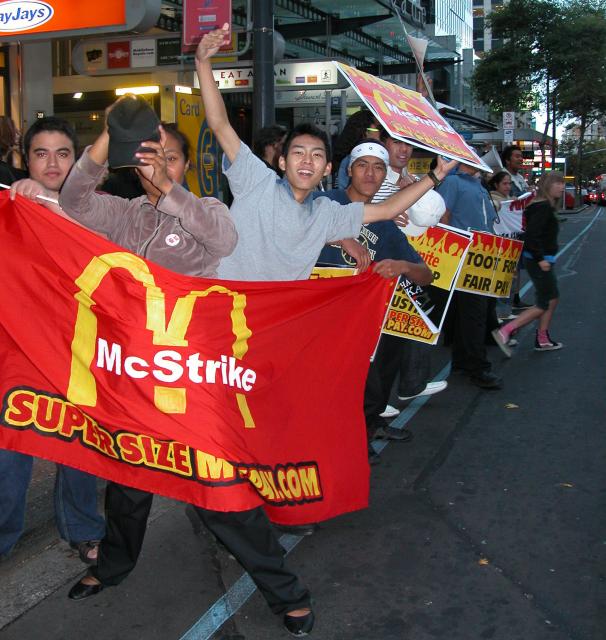
rejected. McDonalds workers were rostered off so they
would be unable to use paid stopwork time to attend
the Town Hall meeting. Staunch delegates in Queens
Street McDs defied company threats that they would be
sued for conducting an illegal strike if they took
action. On Feb 10th 2006, Potu, Ini and Rachel led
New Zealand’s first McStrike. Two days later, up on
the Town Hall stage, in front of hundreds of workers
and supporters, delegate after delegate spelled it out
loud and clear- it was time to spread the strikes far
and wide.

We moved fast. Valentines Day saw a strike in Botany
Downs KFC, under the slogan “Make Love not Profits”.
Customer support for the young strikers was massive-
51 out of 58 cars refused to pass the drive through
picket. On Feb 17th, pickets went up outside KFC in
far north Whangarei. The day after, Starbucks was
rocked to its core in Auckland city centre, with most
stores taking action and both Queen St and K Road
branches completely shut down for two hours.

A youth rates day of action on Feb 22nd saw a rolling
strike disrupt business at KFCs Manukau, Massey,
Lincoln Rd and Balmoral, with the Workers Charter
Freedom bus jammed full of young flying pickets.
Again most customers refused to cross picket lines of
young minimum wage workers on strike, much to the
consternation of KFC managers. One threatened us with
the police and courts.

"As an anticorporate activist for about 10 years I've
seen my share of pickets outside fast food
multinationals like McDonalds and KFC. However
joining the KFC workers on the picket line was a
novel, inspiring and educational experience. It was
incredible to see these young people, many of them
high school students, so fired up about fighting for a
better deal and so confident that their actions could
make a difference.

The Unite strategy of organising a 'solidarity bus'
to carry the willing workers from each picket line to
support the next striking workplace meant that
numbers, excitement and energy levels built up
noticeably through the day. The day of action ended on
an amazing high as the sun went down and I felt truly
honoured to have been part of the day’s strikes and
the SupersizeMyPay.com campaign."
-Danny Strype, Anti Capitalist activist

Before they could draw breath, the companies were hit
again with a whole series of firsts- the first Burger
King strike at Lincoln Rd, the first strike in
Wellington at KFC Porirua, and the first of many
strikes at Restaurant Brands’ Achilles Heel, the Pizza
Hut/KFC call centre. The Westies led the first
Regional strike in West Auckland and in the process
invented the Hooning Pickets- drive throughs picketed
by mobile carloads of strikers, honking and cheering.

"At the start of our Porirua KFC strike all the workers
came out onto the footpath. Somebody mentioned that
there was one worker left inside who wasn't allowed
to come out. So me and Grant Brookes decided to go in
and confront the 10 or so managers. (The lower North
Island were having a managers dinner and they had been
tipped off about the strike so they all decided to
turn up).

We approached the area manager and said "there is one
left and we're leaving nobody behind". The area
manager quickly approached the counter yelling
"Natasha, Natasha you have to go outside".
The worker came out and all was well."
-Kathryn Tucker, Unite’s Wellington Organiser

It was palpable that management was losing control of
its workforce, and that the mood for strikes was
spreading like the Spanish flu. McDonald’s continued
to harass and intimidate union members and delegates
throughout, and in many ways were more viciously anti
union than Restaurant Brands, despite the latter
getting the full two barrels of the union shotgun
during this period. However, there was no real
attempt to bargain by McDonalds- delay and dragging
out the negotiations was their strategy, as they have
done for decades before in other countries. But when
they coupled this with genuine full frontal assaults
on members, paying non union members 75 cents more per
hour, we knew that we had to open the second front.

The 3rd of March was McD Day. “What’s disgusting?
Union Busting!” echoed throughout Auckland, as Golden
Arches in Point Chev, Royal Oak, Manakau, Wairau, Glen
Innes and Glenfield went out on strike, joined by
solidarity action in Starbucks Parnell, 220 Queen St
and the Restaurant Brands call centre. All strikes
converged at McDonalds flagship Queen Street store,
where striking workers are greeted by over a 150
fellow pickets and supporters. Organisers now begin
to realise that the anger is so strong that it could
be time to call people onto the streets to demonstrate
politically. The issue is now one that the community and trade
union movement itself had to get behind.

"Supersizemypay.com campaign was great to be a part
of; there was an incredible atmosphere that if people
worked hard enough, then anything could happen.
Strikes, pickets and marches all made people feel like
something was actually happening, that people were
learning how to take action and create change. I
remember one night when McDonalds went out on strike
and a about 100 of us cruised up and down
Queen Street chanting slogans and singing songs, and
this English backpacker came up to me and was like,
"Fuck, Yeah this is wicked." And then he picked up a
placard and got really involved in it. I think
rebuilding a youth union movement in Aotearoa in the
way supersizemypay has is one of the top priorities
for social justice activists. I hope that
Supersizemypay was just the beginning."
-Omar Hamed, Radical Youth

To the Streets

Our side always has the best songs, and the 18th of
March saw over a thousand workers and supporters mix
politics with music and join together for the Big Pay
Out. McDonalds had rostered off as many union members
as it could, knowing the union meant business from all
the posters and stickers that had covered every
lamppost, wall and notice board in Auckland. So we
went recruiting in stores early that morning, and four
workers who had been in the union for less than an
hour led the strike at McDonalds Downtown, sparking
off a huge march (and charges!) down Queen Street.
There are direct action sit downs and blockades in
front of all major restaurants, with hundreds chanting
“3, 5, 7, 9- Never cross a picket line!” The Union
threw a huge concert in Myers Park, with reggae, hip
hop and hardcore acts like 8 Foot Sativa playing.

The Big Pay Out itself organises hundreds of young
students within the Radical Youth network, ably led by
a new generation of outstanding activists such as
Meto, Nesta, Joe, Sam, Jack and Ming Tsu. They ask
Unite to help provide busses for a massive action they
are planning on March the 21st. On the day, the
Radical Youth Schools strikes pull out another
thousand people on Queen Street, this time mostly
young workers under 18 who leave their colleges. Heavy
handed policing results in two arrests, but the
majority of public opinion swings behind the young
students following statements of support from Unite
Union, the Green Party and the New Zealand Congress of
Trade Unions. The issue is now headline national
news on both NZ TV networks and the major papers.
Commentators make the links between the protests in
Queen Street and the youth uprising that is
simultaneously shaking France.

What began with one Starbucks striker walking off the
job had now become a generational movement, one that
has given hundreds of young people a positive
experience of a union as an organisation that fights
for them. I have no doubt that these will be the
union leaders of tomorrow.

Breakthrough

On the back of the Big Pay Out and the School Strikes,
hundreds more activists are brought into the campaign,
and plans to escalate action nationally were advanced.
It is at this time that we are contacted by
Restaurant Brands, and a serious deal is put on the
table. A deal that the vast majority of delegates and
campaign leaders think is a major breakthrough.

All adult workers at KFC and Pizza Hut get a raise of
just under 8%, with Starbucks workers getting a 75
cents an hour increase across all scales, with another
similar raise locked in for 2007. The call centre
workers get between 11.5% and 14.9%. Shift
supervisors also win an increase on top of this.
.
The company accepts that paying young workers less can
no longer be justified, and commits itself to
abolishing youth rates. As a first step, they move
the pay scale for those under 18 to 90% of the adult
rate. Some young workers get a pay rise of 34%.
Supervisors under 18 get the full adult rate- a 17
year old supervisor can now earn $14.68, an increase
of $3 an hour.

There is a clear commitment to end casualisation, as
the company agrees to give its workers more secure
hours. When additional hours become available in
stores, existing workers will be offered these hours
before new staff are employed. Break times move from
ten to fifteen minutes, and overtime rates are re
introduced for those who work over eight hours per day
or forty hours per week. The union extends these wins
not only to its membership, but to all 7000 workers
employed by Restaurant Brands. In recognition of this
decision Restaurant Brands has agreed to pay every
union member a lump sum equal to 1% of their quarterly
earnings every three months. Effectively it pays the
union fees for Unite members. Union rights to notice
boards, stop work meetings and delegate development
are enshrined. On top of the pay rise, Unite wins
over 20 improvements in conditions for workers. For a
second time in a week, Unite makes front page news in
the New Zealand Herald. Media commentators and
pundits call the deal “historic”.

"The important fact is that workers, who have never
done anything like this before, worked together with
one goal in mind, getting a better deal. My advice to
those who want to follow is to get yourself and your
work mates excited about their futures, to get excited
about how they are going to change their futures for
the better, that they should believe in themselves,
that they have that kind of power. I really think
that we could have saved (campaign) costs by having a
large scale strike. Closing some larger stores down
for a couple of hours would be awesome. Getting on the
news would be great. Any way, I believe that the new
RBL contract is very significant to now, we could have
gotten more, but it is a step in the right direction.
I congratulate all workers who worked towards this
goal. It is a fantastic effort."
-Jennifer Carmichael, Starbucks Strike leader and
Unite volunteer organiser.


"One thing I can add from my own perspective in Lower
Hutt is the change in workers' attitudes towards the
union after the breakthrough deal. Apart from one
fairly solid KFC store, Lower Hutt was not a really
militant region. There are 6 Rest Brands outlets in
Hutt City, plus 2 McDs. During the strikes, some
workers were inspired to join but others just didn't
want to know you as aunion organiser.
They wouldn’t talk to you. After the deal was settled,
most of these people suddenly became
more positive and open. The shift was quite dramatic.

One guy stands out. A KFC cook, he was a union
delegate in the mid-90s in a fish processing plant.
When we signed the breakthrough deal, he joined up and
talked with me for the first time. He said he got a
hammering as union delegate before, and was forced out
of his job. He never abandoned his support for trade
unionism. But only now, I think, does he feel it's
safe to express it again.

In his late twenties, that cook is a bit older than
the typical KFC worker. I had a long battle to get
trusted by workers at the Hutt Central store, where
the manager is extremely hostile to Unite. But the
next visit after the deal was signed, three workers
joined. They also started talking about problems on
the job with the manager, which was a first in my
experience. So in my region, I think winning the deal
has been a boost to confidence and a launch-pad for
workers to unionise and start tackling problems
they've been unhappy about for a while."
-Grant Brookes, Unite volunteer organiser, Wellington


"Maybe one day these young workers and other like them
will run the restaurants themselves and the
anti-corporate campaigns I've been part of will be
replaced with consultation with the workers
collectives to change socially and environmentally
problematic practices directly. Till then all power
to the fast food workers in their struggle for a
better deal, much respect to the organisers at Unite
and to all those campaigning for a world free of abusive corporations
and the social system that creates and supports them."
-Danny Strype, Anti Capitalist activist

Ready to fight "forever".
Now the battle moves onto McDonalds in earnest. That
multinationals refusal to bargain now looks miserly
and mean in the eyes of their workers who can see the
improvements the union won in KFC and Pizza Hut. The
attempts at intimidation and union busting have
strengthened the resolve of workplace delegates and
organisers. Unite has promised that it will fight
McDonalds “forever” until a decent collective contract
is agreed, and now looks to the wider community to
support these minimum wage workers. Last words to a
brave delegate from McDonalds who served legal papers
on McDs management, scuppering their discriminatory
union busting payments-

"As far as I stand I think that the out come with the
Restaurant Brands Limited was a good one. We achieved
great things, and that the workers should be proud for
what they have achieved. As for strikes, I think that
these young workers including myself, should have the
right to strike. They are only fighting for what is
rightfully theirs. I support it in every way.

These so called Office Executives (white collar
Pricks) can't be putting a figure on the amount that
these workers do, when they have never done the jobs
given to us.
Most of these workers are young, first jobs ever. But
they wear their hearts on their sleeves; put all their
sweat into it. They receive nothing for it, no
gratitude or recognition. But all I can say really
is, because my fight has yet to start with
McDonalds, it's really up to us, to do something. I
do not blame workers for making a stand for what they
truly believe in and what is theirs. WE HAVE EVERY
RIGHT! I’LL TRY MY BEST!"
-Heni Moeke, Unite Delegate at Point Chevalier
McDonalds

Workers like Heni need all the support they can get-
she has had her hours slashed and was told that if she
didn’t like it, she could get a job somewhere else.
Whatever happens, there will be an almighty fight for
the rest of 2006, and the eyes of the world will be
on Aotearoa. Solidarity from unions across the
globe, from Europe, Venezuela, Australia and the USA
will be there, as organisations that represent
hundreds of thousands of workers internationally get
behind the workers of the Unite Union. Be one of them
today, and do what you can to support the
SupersizeMyPay.Com campaign….

The workers united, will never de defeated.
Thursday, May 11, 2006

Buiding a union in McDonalds, New Zealand


Our union is a small, activist union that recently led the world's
first strikes at Starbucks, and has since won a substantial
pay deal and improved conditions for our members there
and at KFC and Pizza Hut as well. Details of our
campaign and victory can be found at our campaign
website, www.supersizemypay.com

However, we are also faced with a major challenge in
the next few months with a concerted offensive from
union busters McDonalds, who have threatened to "smash
the Unite union". Our members and delegates have
experienced severe victimisation and bullying, many
workplace leaders having their hours cut, rosters
changed to unsocial hours, or asked to find another
job "if you don't like it here". Recently, they
employed the services of a Kiwi arch union buster,
who embarked on a policy of paying non union members
more money in an attempt to destroy our membership
on the shop floor.

Our members in McDonalds, bouyed by the victories we
won at KFC, Starbucks and Pizza Hut, have now resolved
to fight hard in the next few months. At the moment
we have over 900 members in McDonalds stores in
Auckland alone. But most of these trade unionists are
on minimum wage, and are highly vulnerable. In this
David and Goliath battle, they know full well they
stand against a powerful multinational with billions
of dollars in reserve, and a media, legal and
advertising corps per excellence.

However, we also know that there are millions of trade
unionists around the world who will be inspired if we
can win this fight against McDonalds. It will truly
inspire workers in so called "McJobs" everywhere that
change is possible. As such, key Unite organisers
have gone to the corners of the earth to spread the
word- Senior Organiser Mike Treen to Venezuela and
Bolivia, and Education Officer Chrissy Holland to the
LaborNotes Conference in Detroit. I am visiting
interested trade unions and campaign groups in both
Ireland and Britain, and can be contacted at
solidarityjoe@yahoo.com if you would like to meet up.

I am in the UK meeting General Secretary Mark Serwotka
of the Public and Commerical Services Union on May
16th, and will be meeting other trade union leaders
and groups until the 18th of May. I have a short 15
minute compilation of rushes from an upcoming
documentary being made about the SupersizeMyPay.Com
campaign to organise the unorganised in the fast food
industries. The campaign has been colourful and
energetic, and we want to spread its message through
union websites, publications and branches.

Any help and solidarity
you can give to our small union in this organisational
life and death fight for us would be greatly
appreciated.

Solidarity
Joe Carolan
www.unite.org.nz

Starbucks: Union busters leave a bitter taste


From Socialist Worker 12.04.2005 - 25.04.2005 #240 www.swp.ie
Starbucks to open in Dublin:

By Joe Carolan

THE recent closure of Bewleys saw workers treated like disposable plastic cups, given their notice days before Christmas. So much for ‘traditional’ Dublin. It begs the question; what would Jim Larkin have done? Now, what marketers call the ‘empty emotional space’ is to be filled by the infamous Starbucks chain, who had their windows smashed during the Battle of Seattle. Why all the froth about what some call ‘the McDonalds of Coffee’?

Coffee is coffee, no matter where it is drunk. Starbucks, however, try to brand an experience of drinking it as a cosmopolitan, broad minded, urbane experience, a ‘Friends’ Central Perk culture. A contemptuous commercialisation of new age backpacker chic sees young Urbz sip their Costa Rican Venti Latte in comfy sofas whilst listening to World Music from Burundi or Bahia. Starbucks presents the world as a sensual feast for narcissistic Western consumers to experience, but behind this de-contextualised globalisation lies a reality of ruthless competition, exploitation and union busting.

Globalisation has led to huge drops in commodity prices for cash crops, with coffee growing farmers in East Timor losing 35% of their income since Seattle 1999. In Mexico, it has halved. Reacting to the anger of the anti capitalist movement, and to save money on the glazier bills, Starbucks now attempt a ‘greenwash’ by having a Fair Trade coffee morning once a month. That would mean, logically, that the other 30 days are unfair trade morning, evening and nights.

In the Global North, Starbucks workers call themselves Baristas, a name that echos solidarity with their Southern Zapatista and Sandinista comrades. Baristas are permatemps, workers who suffer from the twin evils of flexploitation- low pay coupled with long, unscheduled hours.

McJobs that do not give you enough hours to have the rights of a full time worker, yet rely on you applying for more shifts because you cannot make ends meet on 5 cents above the minimum wage.

Danny Gross and Anthony Polanco were two baristas who stood up to Starbucks in New York last October, organising a union in the 36th and Madison branch of Starbucks as half a million protested Bush and the Republican Congress outside on the streets. Following a complaint from Starbucks management, they were arrested by cops at a union rally outside, and were sent through the New York courts. Now they have emerged victorious, with Starbucks being found guilty by the NY Labour Board of bullying, harassment and attempting to intimidate union organisers. The IWW (James Connolly’s Wobblies) is now organising baristas nationwide. Irish workers should log into www.starbucksunion.org for inspiration.

Bewleys may be gone, but Globalisation wants to colonise what it sees as an emotional vacumn in public urban meeting space. Before we succumb to the ‘Friends’ brand identity, we should remember the baristas and the coffee campensinos fighting back. Boycott politics is well and good but organising a union there would make millionaire owner (and Zionist) Howard Schultz really smell the coffee.

Young "labourers against Labour" speak out


The SupersizeMyPay.com campaign has politicised young workers in Auckland who before were voiceless and ignored.
JOE CAROLAN spoke to half-a-dozen to see how they viewed the Labour Party and its government, and what they thought may be an alternative.
Briar, Laurent and Sam were leaders of the December 2005 KFC Balmoral strike. The strikers there were, on average, possibly the youngest in New Zealand¹s history. Jen was a strike leader at Starbucks who¹s become a volunteer organiser with Unite Workers Union. Dom is a young artist and graphics designer who has also become a Unite volunteer. Nico is an ³open-minded student with socialist tendencies² who supports the Supersize campaign and the Workers Charter.

Joe: When I say the words ³Labour Party², what comes straight away into your mind?
Sam: Red.
Briar: Helen Clark.
Jen: A bunch of people who made a lot of promises, but sold us out in the end.
Laurent: The lesser evil to Don Brash¹s National Party.
Dom: Bourgeois scum!
Nico: A party for the workers.

Joe: Did you vote in the last election, and if so, for who? If not, why not?
Sam: As well as having to endure youth rates, I cannot vote until I¹m 18. Even so, I still have to pay tax on the little I earn. I reckon if the voting age was lowered to 16, a lot of young workers would vote for parties promising to abolish youth rates. Labour ain¹t one of them at the moment.
Briar: I voted Labour reluctantly, though I would have voted Green if the race wasn¹t so tight. Although Labour and National are mostly fairly similar, I think Labour has more progressive views on some things, such as gay rights.

Joe: Do you think Labour is a more liberal party than National?
Briar: Yes, but I also think they¹ve lost their roots. No Labour Party members physically supported our youth rates strike in Balmoral. You¹d probably see Labour Party banners at the Big Gay Out, but not at a strike led by young workers.
Dom: I meet Labour Party members regularly at my golf club.
Laurent: I voted Labour to keep National and Don Brash out. Although Labour isn¹t really a party that supports strikes anymore, there has been some small changes since they took power in 1999. For example, there¹s the right for unions such as Unite to access the work place and recruit. Workers get time-and-a-half and a day-in-lieu now for statutory holidays, whereas before it was just one or the other. Small things sure, but better than nothing.
Dom: I voted Maori Party to get some Maori representation in parliament.
Nico: I voted Greens in the party vote, and Anti-Capitalist Alliance in the candidate vote. It was a choice between Greens, Labour and the Maori Party. In the end, the Maori Party didn¹t have concrete policy, and the Greens needed the support.

Joe: Do you know anything about the Labour Party¹s past? Do you think they were more on the side of workers than they are now? Why?
Laurent: I know that Labour helped push for a nuclear free New Zealand in the 1980s. They were probably formed in the early 1900s by unionists, laying the foundations for the welfare state and pensions etc. They probably lost all that with Rogernomics in the 1980s.
Nico: I know tost of New Zealand¹s political history has been dominated by the National Party. Labour governments haven¹t lasted very long. I would hope they were originally on the side of workers, but aren¹t sure. When they were founded I think they would have been, but they were hijacked along the way by business interests. They weren¹t on the side of workers in [the waterfront lockout of] 1951, for example.
Dom: Labour has always been shit. Probably less shit than now, but still shit.

Joe: If Labour and its government won¹t abolish youth rates and give a $12 minimum wage now, do you think they should be a focus for protests? How?
Laurent: Absolutely. I think we should make a banner ³Labourers against Labour².
Briar: I agree. It¹s ironic but true. Maybe we should take our union banners to where their activists will be, like the Big Gay Out, to shame them into supporting workers¹ rights.
Sam: We should protest outside their offices, maybe even occupy them. Labour says it¹s against discrimination, but it still won¹t abolish youth rates. That¹s hypocrisy, plain and simple.
Nico: I think they¹re fair game. They¹ve made their bed, now they need an extremely disrupted sleep. A focus could be a shame-and-ridicule campaign on the recent wage rise of MPs. Individual Labour MPs should be targeted.
Dom: I think we should protest this government with milk bottles, boxes of matches, quarts of petrol and rags!

Joe: Do you think workers need an alternative to fight for them? What kind of alternative should it be? How do you think we should organise it?
Sam: Totally. We need a Union Party. And the voting age should be lowered to 16.
Jen: We need a party for the workers.
Dom: We need more militant unions and strikes.
Laurent: We should be pro-New Zealand. I want what¹s best for New Zealanders as a whole, not just New Zealand business or a select few wealthy individuals. I believe we need to stop shipping wealth off to other countries and retain profits in New Zealand. I believe people should have the right to a quality life.
Nico: There definitely needs to be an alternative, to show Labour¹s true colours. If set up right, a new political party would be a huge step to undermining Labour¹s core voting base. We need a party not based on maintaining bottom lines for business. Another idea would be to look for a functioning business that¹s favourable to workers¹ rights and use them as a pin-up model for other businesses and for workers.
Briar: Absolutely, we need an alternative. Unite should form a political party, the Unite Party. You can still support progressive causes without abandoning your support for working people, the young and the poor.
Laurent: We need a union political party, although a general political viewpoint may be difficult to find as there are so many different unions all wanting different things with different employers. I think now more than ever we need a party that will stand up for workers¹ rights and unions, but it shouldn¹t just be Unite-led. Other left-wing people and unions should be invited too, like the Workers Charter.

Would you like a rise with that?


Unite’s Supersizemypay.com campaign to unionise young workers in the fast food multinational chains has taken hold of a generation’s imagination, in a way I haven’t seen since the big pre-war mobilisations of Feb 15th 2003. Make no mistake, this new trade unionism is a social movement of the young, the brown, the immigrant and the poor, and in store after store, we are getting 100% per cent votes for strike action.

I’ve just returned from a night’s visting, recruiting and balloting, meeting workers on the graveyard shifts all over South Central Auckland. In the KFC in Balmoral, same as the Pizza Hut in Royal Oak or the McDonald’s in Greenlane, there’s one sentence I keep hearing from our members and delegates- “when’s it our turn to strike?”. Young workers are flaunting company rules, proudly wearing their Unite union badges and $12 an hour stickers on their uniforms at work, and you can even see them walk differently. Stroppier, taller, more confident- staunch. Itching for their turn to take action in what promises to be Auckland’s Hot Summer.

The Starbucks strike was awesome- when Vicki Salmon, CEO of Restaurant Brands, scoffed on National Radio that there were only three workers going on strike at the K Road store, she ignited the anger of our other Starbucks delegates and members citywide. 35 Starbucks workers took wildcat action, and the Workers Charter Freedom Bus ferried the wildcats down to the rally. Nick, the 16 year old Starbucks worker from St Lukes, spoke at the KFC strike ballot meeting two days later in the Balmoral store. His energy ignited the anger of the workers there, who voted 100% for strike action on December 3rd, the first strike action in New Zealand led by a strike committee made up in the main of teenagers, furious at the discrimination they suffer under youth rates. Teenage kicks aimed at KFC- Kiwis for Cheap...

At times, you feel like the Bolsheviks during the July Days. A premature uprising runs great risks, especially up against the enemies that we face. This is a David and Goliath battle. But what makes you realise that this is a movement for social justice and not just an exercise in collective bargaining, is the energy, creativity and thirst to have a go at the multinationals that you find in every store. Elements of the anti capitalist movement might have been misguided in their calls to boycott these chains- all along, we were really needed inside them organising young working class people.

Socialists and Workers Charter activists have been at the heart of this uprising, and at the time this article was written, were building flat out for a solidarity rally with the 30 brave KFC workers striking at Balmoral. In the weeks to come, the strikes will spread out to Lincoln Road, Royal Oak, and into the centre of the city and Queen Street. At the Unite strategy meetings, we often talk about Farrell Dobbs and the Teamsters rebellion in Minneapolis- and how a small group of dedicated socialists could build a massive citywide union movement. Hopefully this summer we will have our Fastfood Rebellion, and we hope thousands of low paid workers in petrol stations, supermarkets and video stores go on to follow our example.

Now, would you like a rising with that? Super size my pay dot com!

Joe Carolan
November 2005

Also see Starstruck- David and Goliath
http://www.indymedia.ie/newswire.php?story_id=73204

and Union Busters leave a bitter taste
http://www.swp.ie/socialistworker/2005/sw240/SW-240-web.pdf

Friday, July 01, 2005

Manufacturing Dissent- A Democratic Media System to replace the Propaganda Model?


Can James Curran’s ideas regarding a “democratic media system” can accommodate the inequality concerns identified in Herman/Chomsky’s Propaganda model?

Introduction

According to the ideology of liberal democracy, the independent media functions as a “Fourth Estate”, a watchdog over the affairs of business, politics and society. Its funding by the free market is supposed to guarantee its independence from government- ideally, it is autonomous from the State, unlike the experience of mass media in Nazi Germany or Stalinist Russia, where it was a mere vehicle for State Propaganda. However, the concentration of media ownership in fewer and fewer hands, coupled with an ideological bent in favour of the status quo, has led many critical thinkers to question the mass media’s impartiality and objectivity, instead seeing it as an actor on the side of privilege and inequality. Most prominent amongst these theorists in recent years have been Noam Chomsky and Edward Herman, whose Propaganda Model provides a framework for evaluating the ideological function of mass media in late capitalism.

The Propaganda Model (PM) argues that the mass media face hidden forms of control- five main filters which suppress news items, limit their running time or slant their coverage. These filters are (1) Ownership (2) Advertising (3) Sources (4) Flak and (5) Anti- Communism (today probably better defined as Anti-terrorism). Chomsky/Herman also try to explain why dissident voices are marginalised in a media that is increasingly part of a global corporate structure, that it has an inbuilt bias to portray strikers as disruptors of the economy, or anti globalisation protestors as violent radicals.

1. Ownership

The early history of the print media in Britain was characterised by a proliferation of radical newspapers aimed at the working class. Growing on the back of the Chartist movement, papers such as the Poor Man’s Guardian and the Red Republican dwarfed the readership of pro establishment newspapers such as the Daily Mail or the Times. They provided an alternative world view to the dominant ideology, one that challenged the economic status quo so much that authorities made use of the libel laws and coercive “stamp duties” to drive the radical media down. Readers pooled their resources to resist these fines and taxes successfully- in the end, these papers were driven out of the marketplace by the rising capital costs of new printing technology. Today, publishing a national newspaper or running a TV channel requires significant capital unavailable to most.

The fact that media outlets are mostly privately controlled corporations gives their owners huge power over editorial decisions. Media barons such as Conrad Black, Rupert Murdoch, Silvio Berlusconi and Tony O Reilly control huge swathes of both national and international print and broadcast media, oftentimes wielding considerable political power- e.g. Murdoch backed Blair’s New Labour for election in his tabloids, whilst Silvio Berlusconi emerged from the political wilderness to become Italy’s Prime Minister by using his control of most of Italy’s TV channels and press.


The modern mass media in America and Europe are now huge businesses which are often owned by larger corporations. For example, American TV networks CBS and NBC are owned by Westinghouse and General Electric respectively. Herman and Chomsky point out, for instance, that: 'GE and Westinghouse are both huge, diversified multinational companies heavily involved in the controversial areas of weapons production and nuclear power.' GE has also “contributed to the funding of the American Enterprise Institute, a right wing think tank that supports intellectuals who will get the business message across” E. Herman and N. Chomsky, A Propaganda Model, Chapter 16, Media and Cultural Studies Keyworks, Blackwell Publishing, 2002. (p288).

These organisations are thus far from neutral players in society, and as corporations would be in favour of free market ideology. Managers of media organisations are thus constrained by the profit orientation of their owners, and reportage critical of this ideology would tend to be side lined.
2. Advertising

The second filter of the propaganda model is advertising. Most modern newspapers (and TV stations) are funded by advertising, which gives the corporations who advertise with them considerable economic power over these outlets. Oftentimes the culture of these organisations is socially conservative. Businesses can threaten to withdraw advertising if the media constantly air criticisms and exposes over their labour practices or environmental records. “Working class and radical media also suffer from the political discrimination of advertisers- political discrimination is structured into advertising allocations by the stress on with money to buy. But many firms will always refuse to patronise ideological enemies and those whom they perceive as damaging their interests”. Ibid., (p291)

3. Sourcing


The third of Herman and Chomsky's 5 filters relates to the sourcing of mass media news: 'The mass media are drawn into a symbiotic relationship with powerful sources of information by economic necessity and reciprocity of interest.' Even large media groups such as RTE or BBC cannot afford to have reporters and cameras everywhere a story happens- they must concentrate their resources where significant news occurs. This leads many media outlets to rely on what are known as the “Primary Definers”- the press conferences of the Pentagon, 10 Downing Street, elected politicians, the Police, government scientists or ‘recognised experts’. Because these people are recognised or powerful, what they say is news- they “define the agenda”. Journalists, who constantly take the side of the nameless masses, be they strikers, anti war demonstrators or global justice activists can be readily accused of partisan bias, even though members of these groups can often have more relevant information than the Primary Definers. 4. Flak

The fourth filter is 'flak', which Herman and Chomsky define as ‘negative responses to a media statement or [TV or radio] program. It may take the form of letters, telegrams, phone calls, petitions, law-suits, speeches and Bills before Congress, and other modes of complaint, threat and punitive action'. (p298)

Chomsky sees these organisations as mostly right wing front organisations of groups such as the Petrochemical Agency, the ‘Intelligence Community’ or big business, whose constant, systematic and organised criticism of the “biased”, “left wing”, “liberal” media creates a perception that the media are going too far or are imbalanced, erring on the side of the radical left.5. Anti-Communism / Anti-Terrorism

Herman and Chomsky created the PM during the Cold War, but the political hostility of the West towards the former Soviet Bloc can today be seen in the ideological offensive waged through the “War on Terrorism”. In times of war, the media is expected to “back our boys”, to demonise the enemy as evil, irrational and inhumane.
The adage that “one man’s freedom fighter is another man’s terrorist” can be seen in the semiotic shift in Afghanistan, where groups who were originally backed by the West as Anti-Soviet patriots and freedom loving Muhjahadeen, became evil Islamist murderers. Ideological hostility towards radical left movements is still part of the media’s vocabulary- witness the tabloid strategy of tension leading up to the Mayday 2004 protests in Dublin. Chomsky and Herman claim that the mass media attempt to constrict debate between “conservative and liberal wings”, with anything further to the left seen as irrational or “loony”.


It is difficult to synopsise an intricate model in the space of a thousand words, but these five filters provide for considerable inequalities in the mass media’s treatment of dissenting voices. To counter this propaganda model, James Curran proposes a social-democratic, third way- one that he calls a Democratic Media System.

The Democratic Media System

Curran sees the media as a major player in what Jurgen Habermas calls the public sphere, which Habermas describes as “a space where access to information affecting the public good is widely available... within this public sphere, people collectively determine through rational argument the way in which they wish to see society develop, and this in turn shapes government policy. The media facilitates this process by providing an arena of public debate and by reconstituting private citizens as a public body in the form of public opinion”.
Summarised in J. Curran, Media and Democracy: the Third Way, p233-4

However, for Curran, contemporary political society is no longer made up of autonomous individuals, which he sees as “an 18th century archaic idea of polity”.
Instead, individual citizens are represented by organisations such as political parties, civil society, NGOs and social movements etc. Societies core is formed by Government, the civil service, the judiciary, parliament, political parties, elections and party competition, which are regulated by various agencies. Outside this core are two groups- (a) Customers such as business associations and labour unions, and
(b) Suppliers such as voluntary associations, public interest groups, and the new social movements.

The Democratic media system (DMS) should enable these opposed or separate groups to express themselves effectively, and “aid a process of communal understanding and equitable compromise”. It needs a well developed specialist sector- an activist minority media assisting collective organisations to recruit support- and sees the representative role of media helping civil society to be effective. Above this he sees a general media sector- who in a “shared search for solutions”, facilitate democratic procedures.

The DMS has a pluralistic design, because, as Curran observes:
“In most societies, the media are linked to the hierarchy of power, and tend to promote social integration on its terms”. It is “Publicly accountable in multiple ways… its architecture is designed to create places for the incubation and communication of opposed viewpoints, and a common space for their mediation” p241.

Thus it can be seen to address some of the concerns of the Propaganda Model.

At the Core of the DMS lie general interest TV channels with a mass audience.
These are fed by four peripheral media sectors, some of which facilitate dissenting and minority views. The first two can be seen in most European countries with a state broadcasting regime. These are-
1. A Private sector which “relates to public as consumers, and acts as a restraint on over entrenchment of minority concerns to the exclusion of majority pleasures.”
2 A Professional Media: modelled on the values of public service broadcasting networks such as RTE or the BBC, which allows professional communicators operate with a minimum of government constraint.
.
In addition, he sees two other sectors-

3. A Social Market sector, where the state subsidises minority media to promote market diversity, media pluralism and choice. He points to the fact that many European countries have some form of anti-monopoly media legislation. This allows their TV channels to commission quotas for home-grown programming- for example, the support for films in France, or in the UK, Channel 4 commissioning programmes specifically for ethnic or subcultural minorities.

4. A Civic Media sector, which will provide channels of communication linked to organised groups and networks. Curran sees these primarily as activist organisations within civil society- they include political parties as well as new social movements, and he organises them in three tiers-

Propagandist links between civic organisations and the wider public, building support for partisan perspectives and sets of political objectives.
Subcultural networks. Gay/lesbian magazines, travellers multicultural and immigrant media, relating to a specific social constituency
Intra-organisational media e.g. trade union journals, student union publications which hold leadership accountable to their rank and file membership.

He sees two ways to reinvigorate civic media-
(a) Grants- “In Norway, the weekly journals of the political parties, immigrant groups and other organisations receive financial support amounting in 1995 to £2.6 million
(b) Bandwidth- an alternative is to assign “spectrum, technical facilities”
Civil society should exercise control over publicly owned bandwidth through lease and time share, radio and TV channels- this has been carried out in Cable TV networks in several US cities, where the resultant actors are largely ideological, religious or social organisations.

Addressing the concerns of the Propaganda Model

Curran essentially argues that with increased state funding, either through direct grants or through help with start up costs in the ‘Social Market’, society can increase media access, democracy and diversity. In addition, the demands for a Civic Media control of bandwidth is an idea that has arrived- the technology of Digital TV and Internet radio confounds previous government regulatory arguments that bandwidth was a “scarce resource”. These positions are supported by a wide range of civic and community groups in Ireland who are federated to the Community Media Network (www.cmn.ie ), and there are active campaigns to realise some form of the DMS throughout Europe and beyond. (See the European Forum for Communication Rights at www.efcr2004.net or www.communicationrights.org )
.
However, a major criticism of the DMS is that it seems to believe in a holistic, ‘conflict resolution’ approach to ideological conflict, a methodology reminiscent of Tony Blair’s over-hyped ‘Third Way’. The strength of Harman and Chomsky’s Propaganda Model is that it identifies an irresolvable tension between mass media and audience, one that is rooted in the nature of capitalism itself. Although the DMS may provide alternative channels to the mainstream, the mainstream will continue to act in a biased and ideological way, and will seek to hegemonise, ridicule or marginalise critical opinion.

Many media and egalitarian activists continue to build independent media- and editorial independence from state funding is very important if the State is not also a neutral arbiter. Radical newspapers such as Socialist Worker, the Voice and An Phoblacht have won themselves an audience and base by taking the side of the powerless. There is a danger in Chomsky’s model of seeing the media as a homogenous, right wing bloc- there are still many spaces where critical voices can be heard. Within the mainstream media, courageous journalists such as John Pilger, Robert Fisk, Eamonn Mc Cann and Paul Foot continue to win space, hearts and minds to an anti-capitalist, anti-war perspective. We must also remember that just because certain media push a right wing message, the audience can oftentimes decode this in a negotiated or oppositional way. The effects of the propaganda model, even without the mediation of a DMS, are not akin to a Hypodermic injection of ideology to the brain. An audience will resist messages it knows it is untrue if it has alternative sources of information e.g. the huge trade union strikes that toppled the first Berlusconi government- no matter how many TV stations he owned, his propaganda couldn’t change the fact that he wanted to half people’s pensions!

Finally, DMS or no, the internet has provided a horizontal networking communication tool unprecedented in history. Inspired by the anti capitalist movement, the global phenomena of indymedia.org finds its Irish _expression at www.indymedia.ie, where activists instantly publish text articles, photographs, audio and video clips that can reach an international audience. The revolution may not be televised, but it will certainly be organised on the web!

Bibliography
James Curran, Media and Power, Routledge London
In particular Chapter 8, Media and Democracy: the Third Way, p233-4

E. Herman and N. Chomsky, A Propaganda Model :Chapter 16 in
Media and Cultural Studies Keyworks, Blackwell Publishing, 2002.


Colin Sparks, Resistance: the Movement, the Media and the War

International Socialism 98 (Spring 2003), London, 2003.


Websites : www.cmn.ie, www.indymedia.ie, www.communicationrights.org .

Challenging the Corporate Media- The Press Barons Ball


The Press Barons BALL

VIDEO of the protest against the
WORLD ASSOCIATION OF NEWSPAPERS SUMMIT IN DUBLIN, JUNE 9

MONDAY JUNE 9th- 12 noon: GR picketed the opening ceremony of the World Newspapers Congress at the RDS. That evening at 8pm, there was a loud and colourful demonstration outside the reception being held for the WNC at the Guinness Storehouse in James Street. Top hats, monocles and copies of the Scum abounded at the Press Barons Ball!
http://uk.indymedia.org:8081/local/webcast/uploads/j9media.wmv


Joe Carolan, GR-
“Many people feel that the corporate media present a biased view of the world. Anti war activists feel that our side of the argument was marginalised in favour of the pro war pundits- many newspapers sided with Bush and Blair’s hollow arguments for war on Iraq- but where are the WMDs? The myth making power of corporate media was seen by many as pro war propaganda, with only a few principled journalists like John Pilger or Paul Foot cutting against the mainstream.”

“But it is not only wartime propaganda that we are protesting against- Print Media also re inforces many stereotypes and myths in daily life about the role of women, the status of refugees and asylum seekers, and the validity of workers taking strike action to defend jobs and services against privatisation. Corporate print media is not a free press- huge corporations like Rupert Murdoch’s News International, Tony O Reilly’s Independent Newspapers and Lord Conrad Black’s Express Group are part and parcel of an economic system that puts profit before people- indeed all three corporations have been involved in attacks on their own journalists and printers unions.”

“Trade unionists who have been vilified as dinosaurs and militants, asylum seekers and refugees who have been demonised as scroungers, women who feel that the media peddles sexist stereotypes of their bodies, will join anti capitalists who believe we need an alternative radical press, a true free press from the grassroots.”

Thursday, June 16, 2005

The Politics of the SWP


The Socialist Workers Party wants to end the vast inequality of wealth in Ireland and the wider world. The control of the resources by a tiny few is at the root of a host of other evils, most notably racism and war.

Let us first outline what we seek to change :

Class polarisation in Ireland:
A tiny elite of the super-rich control our country and ensure that the main right wing parties, Fianna Fail, Fine Gael and the Progressive Democrats implement policies which favour their interests.
Ireland has one of the lowest rates of tax on profit in the EU and this allows the banks, for example, to pay a lower proportion of tax than most PAYE workers do on their wages.
Most of the richest people - for example Tony O Reilly - designate themselves as 'tax exiles' by claiming to reside outside of Ireland for 183 days a year, so escaping many taxes.
The result is that Ireland has a first world economy - and third world public services. There is simply not enough money invested in health, education, and crèche provision. In effect, the majority subsidise the tiny elite by putting up with inadequate services. We are also increasingly subject to 'user fees' to avail of basic services.
Bin charges, hospitals charges, 'registration fees' for universities are all forms of indirect taxes. They are also usually the first step towards privatisation.
In the last decade there has been an enormous transfer of wealth - to those who are already wealthy. The share of national cake going to wages, social welfare and pensions has fallen by approximately 10 percent - while the share going to profits, dividends and rent has risen by 10 percent.
The Socialist Workers Party supports every struggle to reverse this state of affairs.
Global Divide:
Every morning a national newspaper could run a headline: 'More than 20,000 people perished yesterday of extreme poverty'.
The fact that none have ever done this is a testament to their priorities.
This level of suffering is not 'inevitable' and it does not happen just because African countries are 'corrupt' (If corruption by political leaders were the cause of poverty, then Ireland would be experiencing a famine!).
Its root cause lies in an economic system that vests control of the resources of the planet in the hands of large corporations.
The Make Poverty History campaign has been launched by Nelson Mandela to dynamise
world opinion into seeking change and we fully support its central themes - cancel the debt; aid programmes with no strings; trade justice. However, we go further.
Currently, just three super-billionaires own more wealth than all of the people of sub-Saharan Africa.
The corporations they control dictate the world's economic priorities - leading to resources being squandered on arms spending or advertising.
Millions die, for example, from curable diseases because the large drug companies spend one third of their resources on advertising and only 11 percent on research.
They try to stop cheaper 'generic drugs' coming on stream as these might reduce their profits.
Ending poverty on a global scale will involve a challenge to this economic tyranny.
Permanent War:
Behind the façade of democracy, the US remains a colonial power in Iraq, seeking to make that country safe for giant firms like Bechtel and Halliburton.
It is singularly failing as it faces a huge insurgency that it cannot crush.
The military and industrial complex that runs America, however, is still determined to spread its empire across the world.
In a recent article, Naomi Klein has shown how the White House has created an Office of the Coordinator for Reconstruction and Stabilization, headed by former US Ambassador to Ukraine Carlos Pascual.
Its mandate is to draw up elaborate "post-conflict" plans for up to twenty-five countries that are not, as of yet, in conflict.
Under the guise of 're-construction', the aim is to open up poor countries for neo-liberal policies that align them closely with their masters in Washington.
The Socialist Workers Party has played an important role in helping to forge an anti-war movement. Our primary target at the moment is ending the use of Shannon airport by US troops.
Over 150,000 US troop passed through Shannon last year, making it one of the largest transport hubs for the US occupation of Iraq.
The airport has also been used to transport prisoners to Guantanamo Bay and other torture centres, but the corporate media in Ireland ishiding this national scandal.
Nevertheless, we are determined the break the silence and seek to mobilise in opposition.
Racism:
The case of the GAMA construction workers shows how immigrant workers are being mistreated in Ireland.
They were paid less than €3 an hour - even though wages in the construction industry should have been €12. The PD leader Mary Harney personally went to Turkey to invite GAMA to Ireland.
She was told in April 2003 about the under-payment of workers- yet she did nothing to resolve it.
The workers were intimidated into speaking out for a long period by the work permit system.
The permit is only given to the employer - and if workers seek to improve their conditions they can be repatriated.
GAMA is a clear case of how racist treatment of immigrants is used to bolster profits.
But racism also operates in a more general way through successive media campaigns which try to scapegoat asylum seekers.
The stories present asylum seekers as 'spongers' who want to simply use Ireland's social welfare system.
This type of racism deflects anger away from the real spongers in Irish society - the tiny elite whose greed is endless.
The Socialist Workers Party central policy can be summed up as follows: Stop deportations - migrant and Irish workers unite and fight.
How did we get here?
How did all inequality this come about? Why did the elected government not look after the people who put them into office?
To understand what is happening we need to 'join the dots' as the problems we face do not stem from a few bad rulers or simply reflect human nature. Their root cause is a socio-economic system that puts profit before people.
Industrial capitalism is a comparatively recent phenomenon, starting just after 1750 with the Industrial Revolution. Originally, it was based on many small firms competing over prices and more efficient means of production. The most successful capitalist did not squander profits on luxury goods - but rather re-invested a high proportion back into production. This led to a regime of 'accumulation for accumulation sake' where human need took second place to the competitive drive to expand.
Under late capitalism, this dynamic continues - but gets worse. Thousands of people now co-operate across the globe to produce simple goods - but control of the process lies in the hands of a few Boards of Directors of large corporations. These directors are unelected and driven only by the need to 'maximise shareholder value'. The corporations have grown so huge that they now dwarf many countries with General Motors, for example, being bigger than Poland, South Africa or Ireland. In every sector of the economy, there are usually only a handful of large firms which control production and form oligopolies to share out the wealth between them. They grow ever closer to the state and seek to fully subordinate its institutions to their interests.
So the reality is that modern capitalism is run by a business class who operate behind the scenes to make sure policies suit their interests. Recent revelations at the corruption tribunals give some idea of how it works. Top business people in Ireland established a secret Ansbacher account to pay the former Taoiseach Charles Haughey a monthly bribe of £20,000. Haughey in turn looked after their interests by slashing taxes on profits.
Even when brown envelopes are not handed over, money dictates how important decisions are made behind the scenes.
Wealthy business people blackmail governments by claiming that if they do not get a good enough profit they will move their companies elsewhere. They form close networks with the top politicians so that what is seen as good for business is good for the country. The power of money means that democracy is undermined.
Parliaments no longer hold the real power in this society. Most of the decisions which affect our daily lives are made in the boardrooms of big business. Having a socialist in the Dail is important as Joe Higgins has shown but real change will not come just from parliament. Big business can be only successfully challenged when huge numbers of workers take action against its rule.
The Socialist Workers Party always points to the power of workers to bring change from below because our fundamental belief is that socialism be based on self-emancipation. It cannot be handed down from on high - it must be taken by a movement that starts at the bottom.
What is socialism?
Socialism means that production is based on human need and is not designed to satisfy the greed of the few. Instead of large factories and offices being run by private individuals whose sole interest is profit, they should be controlled by those who work.
The market should not dictate what is produced but the majority of people should be able to debate and plan what is needed for society as a whole.
Socialism therefore involves a huge extension of democracy. Under capitalism, you get to vote every four years and during elections we are told we have 'a say in running the country''. But the next morning when you go past the factory gate or the office door, nothing has changed. The boss is still dictating everything.
The global anti-capitalist movement which sprung to life after the great Seattle protests against the World Trade Organisation in 1999 is not content with this fake political democracy. It wants economic democracy as well.
We should not allow institution like the World Bank, the IMF and the WTO to dictate our lives. We should have say in how our jobs and colleges are organized. We need workers' control of the factories and offices so that the majority of people make democratic decisions about the issues that directly affect them.
When the majority controls production much of the insanity that comes with capitalism can be eliminated. There would be no need for an arms industry or for nuclear power plants, which produce plutonium as a by-product for nuclear power.
The multi-nationals would not be allowed to dictate what we eat by producing genetically modified food. The debts of underdeveloped countries in Africa and Asia would be cancelled instead of feeding the greed of the bankers.
Socialism also means co-operation rather than endless competition. Today humanity faces huge problems like the spread of AIDS or climate changes that could threaten the planet itself in the future. Instead of different companies hiding their research in the name of 'commercial secrecy' or fighting each other, socialism means that we pool resources to solve problems.
How do we get there?
We need to be organised to get socialism because those who run this system are highly organised. The use the state machinery to crack down on workers struggle. They control the media and use it to spread ideas, which divide workers.
However their system is anarchic and even they cannot fully control its workings. Our rulers are like a band of hostile brothers who unite to defend their privileges but who can also turn on each other.
All of this means there will always be struggle against their rule. These struggles manifest themselves in different ways. Most directly, it involves workers fighting for better wages and conditions. But it also involves struggles over bin charges, or resistance to evictions or students looking for decent grants because those who control capital deprive society of valuable resources.
The aim of the Socialist Workers Party is to link these struggles into a challenge to capitalism itself.
In practice this means that the SWP organises:
* In anti-war and anti-capitalist movements
In the recent past, a host of social movements have sprung up to challenge the priorities of the system. Before the attack on Iraq, the Irish Anti-War Movement was able to mobilise over 100,000 people to march against war and has sustained protests ever since. Beyond that there is a wider anti-capitalist movement which meets regularly in events like the European Social Forum and the World Social Forum to discuss its priorities. One of the main themes is to 'Think Globally, Act Locally' so it seeks to draw links between resistance to privatisation and the wider policies of the IMF and the WTO. The Socialist Workers Party believes in building and expand these movements. We work alongside a host of people who oppose the way the system work but do not necessarily draw socialist conclusions. Through common struggle, we seek to show that there is a real alternative to the system.
* In the Unions
Workers have huge power to bring change but are constantly told there 'is nothing that can be done'. This defeatist message, often unfortunately promoted by some union leaders, has led to a weakening of the unions. One result is that people often work under more stressful conditions, for longer hours and do not get full premium payments for Sunday or weekend work. The Socialist Workers Party is for a return to strong, fighting unions and our members occupy key position as shop stewards or union representatives. We argue for solidarity action between workers and oppose the idea of social partnership as a device to get workers to accept less than what they deserve in a booming economy. We press for the election of all union officials and argue they should be paid no more than the members they represent should.
* In local areas
The SWP organises branches across the country and they take up a host of issues that affect people in their area. This can mean fighting to prevent swimming pools being taken over by private companies - or simply looking for better community facilities. Throughout these struggles we argue that people should rely on themselves, that 'people power' and forging links with organized workers is the key to winning.
* In the Colleges
The SWP is the most active political organisation in many campuses. We hold regular meetings to promote socialist ideas and press for militant action to galvanize students. At all times we stress the need for students to link up with struggles outside the colleges.
Standing up against oppression
In all of these activities socialists promote the common interests of working people. Capitalism constantly tries to divide and rule, seeking to convince one group that they are superior to others. So Northern Ireland, for example, was supposed to be 'a Protestant state for a Protestant people'.
Socialists oppose all forms of oppression because they divide workers and tie one section of workers to their rulers.
This is why the Socialist Workers Party has been to the fore in organizing marches against racism and in saying that 'refugees are welcome here'. We have campaigned actively for the right to divorce without huge financial penalties, a woman's right to choose, and for the right of gay people to live without discrimination.
In Northern Ireland we argue that there is far more uniting Catholic workers and Protestant workers than dividing them. We seek to persuade Protestants to turn their back on loyalist ideas which promote superiority and for Catholic workers to reject the idea of a 'pan-nationalist alliance'. We fight for a 32 county socialist Ireland that will rise out of a challenge to both Irish states.
How we organise
The SWP is organised into local branches, which meet regularly. The meetings are practical and pull together activists who want to organise in their area, workplace or college. We also hold regular socialist forums to bring socialist ideas to a larger audience.
Becoming member of the party means joining the fight against exploitation and oppression. It entails taking a few copies of our paper Socialist Worker, participating in the activities of the local branch and paying dues.
The SWP is open to all no matter how tight their time constraints because of family or work.
The main thing is a commitment to advance the cause of socialism in whatever way one can.